Hands-Free Dog Leash Guide: Who It Suits, Fit and Safety
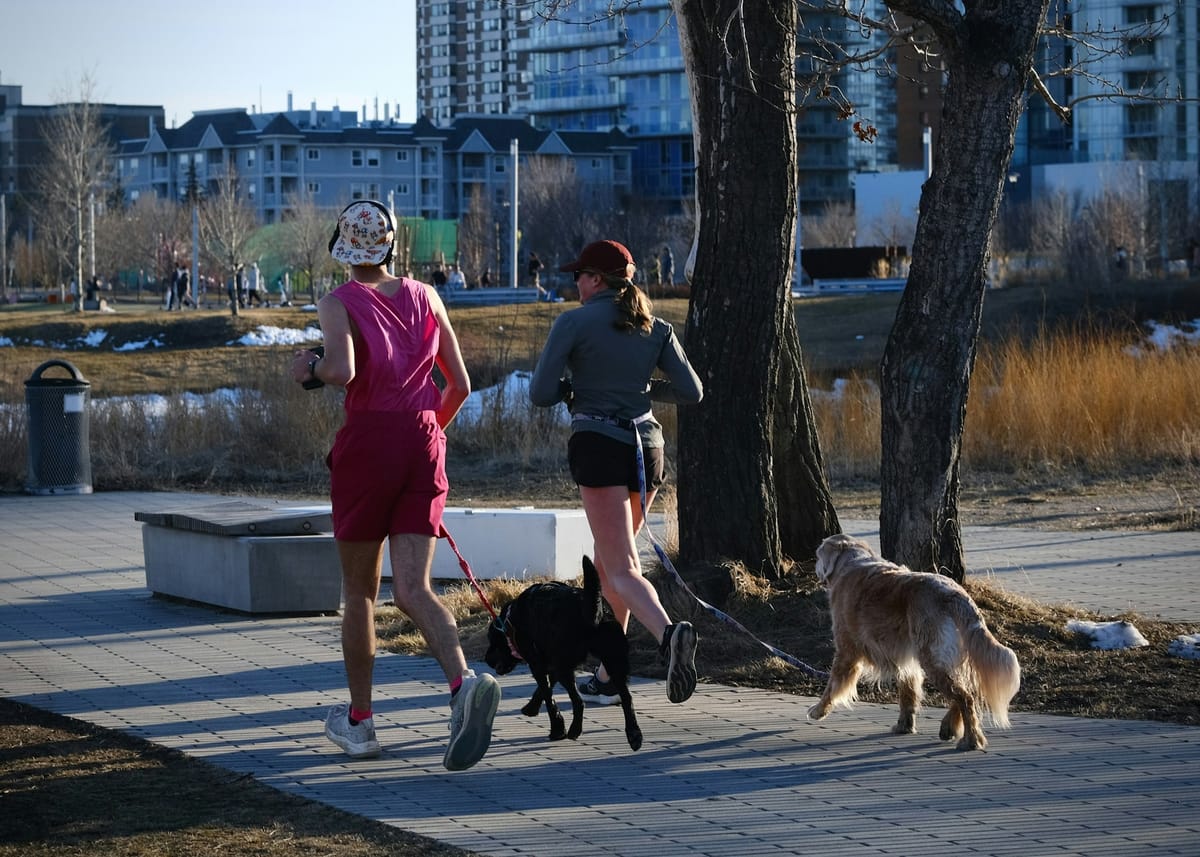
A hands-free dog leash clips around your waist instead of filling your hand. It is popular with runners and with parents pushing a stroller. It works well for a dog that already walks calmly on a loose leash. For a dog that pulls or lunges it adds risk, because you cannot let go of a leash that is buckled to your body. This guide covers what a hands-free leash is, which families and dogs it suits, which it does not, and what to check before you buy one, using guidance from the American Kennel Club (AKC), the American Veterinary Society of Animal Behavior (AVSAB) and a JAMA Surgery study on dog-walking injuries.
What a hands-free dog leash is
The AKC describes a hands-free leash as an adjustable loop worn around your waist, with the other end clipped to the dog's collar or walking gear. Most have three parts:
- A waist belt that sits around your waist or hips and closes with a buckle. Some are wide and padded, some are a simple strap.
- The leash, usually nylon webbing or rope, that attaches to the belt with a clip or ring. Many slide along the belt so the dog can switch from your left to your right.
- Often a bungee section, a stretchy part of the leash that gives a little when the dog speeds up or stops.
Some listings call it a hands free leash, a waist leash or a running leash. Others are a regular dog leash with an extra handle that converts to a belt or a crossbody strap. They all attach the dog to your body instead of your hand.
Who a hands-free leash suits
- Runners and joggers with a trained dog. For dog running, the AKC lists a hands-free leash as an option once your dog runs well beside you, and your arms stay free to swing normally.
- Parents with a stroller, with a very reliable dog. If your dog already walks calmly on a loose leash in busy places, a waist leash leaves both hands for the stroller. If not, see the next section.
- Hikers. On trails you may need your hands for poles, a child's hand or a steep section.
- Calm, steady walkers of any size, from small dogs to large dogs, as long as the dog does not lunge.
Who should skip it, at least for now
A hands-free leash moves the dog's pull from your hand to your center of gravity. If a dog lunges at a squirrel, you cannot simply open your hand, so a sudden pull can knock you off balance. That matters more than any feature on the belt.
- Dogs that pull or lunge. Teach loose-leash walking with a standard leash first.
- Reactive dogs that bark or lunge at other dogs, people, bikes or cars. You need to be able to steer and create distance quickly, and a belt makes that harder.
- Puppies. The AKC says running generally is not safe for puppies because their bones are still growing, and to wait until about 1.5 years for most breeds before running together.
- Older adults and anyone with balance or bone health concerns. A 2019 research letter in JAMA Surgery counted about 32,624 fractures from falls while walking a leashed dog among U.S. adults 65 and older treated in emergency rooms from 2004 to 2017. Yearly cases rose from about 1,671 to 4,396 over that time. About 79 percent were women, and hip fractures made up 17.3 percent. The authors suggested obedience training so dogs do not lunge while leashed.
- Walking with a stroller and a dog that is still learning. If the dog pulls, the stroller goes with you. Hold the leash in your hand until walks are boring and predictable.
Train loose-leash walking first
The AVSAB, a group of veterinarians and behavior researchers, says reward-based training should be used for all dog training, and that aversive methods such as leash jerks, prong collars and shock collars should not be used. For leash manners, that means rewarding your dog with treats or praise for walking beside you on a loose leash. A certified reward-based trainer can help if pulling does not improve.
The AKC's advice on training a dog to run with you follows the same order:
- Get a vet checkup first to make sure running is safe for your dog.
- Start training at a walking pace, with treats delivered at your side.
- Pick one side, left or right, and stick with it so the dog does not cross in front of you.
- Build up slowly. Add short running stretches to walks and increase them over several weeks.
- Watch the weather. The AKC notes dogs cannot handle heat and humidity as well as people can.
Once your dog walks well on a standard 4 to 6 foot leash, switch to the hands-free leash at a walk in a quiet place, then add speed. If you want ideas for building fitness together, our post on working out with your dog has more, and short practice sessions like the ones in teaching your dog new cues help with focus on walks.
What to check before you buy
You do not need the most expensive belt. You need one that fits, closes securely and is easy to unclip in a hurry.
- Belt fit. Look for an adjustable belt that fits your waist or hips over the clothes you actually walk in, including a winter coat. It should sit snug without riding up.
- Buckle and clips. Check that the buckle and the clip at the dog's end are metal or sturdy and close fully. Practice opening the belt buckle with one hand. If a dog takes off after something, being able to release the belt quickly matters.
- Leash length. Shorter is easier to manage for running. Most standard leashes are 4 to 6 feet, and the AKC advises against retractable leashes, which can extend up to 30 feet, for dogs that are not leash trained. A retractable line on a waist belt gives a dog a long runway to build speed.
- Bungee or not. A bungee section softens small tugs and changes of pace. It does not make up for a dog that pulls, and a long bungee can let a dog get further ahead than you expect. Choose a short bungee if you want one.
- Material. Nylon webbing is light and dries fast. Rope leashes are comfortable in the hand. Either works if the stitching is tight and there is no fraying near the clips.
- Visibility. Reflective stitching helps drivers see you on early morning or evening runs.
- Two-dog setups. Some belts take two leashes. Only try this when both dogs walk well alone, since two dogs pulling in different directions is hard to control even by hand.
Where to clip on the dog
For a dog that walks calmly, a flat collar or well-fitted chest-clip walking gear both work. Do not attach a hands-free leash to a choke chain, prong collar or other correction collar, which AVSAB counts among aversive tools. If you are unsure what your dog should wear, ask your vet or a reward-based trainer to check the fit.
Using a hands-free leash safely
- Start on a quiet path, not a busy street.
- Keep your hands near the leash for the first weeks so you can grab it fast.
- Skip ice, wet leaves and steep downhill sections until you and the dog are well practiced.
- Switch back to a hand-held leash in crowds, near traffic, or anywhere your dog gets excited.
A hands-free dog leash is a tool for a dog that already walks well. Get the walking right first, then add the belt.
Sources: American Kennel Club, Choosing the Right Dog Leash and How to Train Your Dog to Run With You; American Veterinary Society of Animal Behavior, Position Statement on Humane Dog Training (2021); Pirruccio, Yoon and Ahn, Fractures in Elderly Americans Associated With Walking Leashed Dogs, JAMA Surgery, 2019.